Cill Dara Shinn Féin Poblachtach

Posts mit dem Label Republican Sinn Féin werden angezeigt. Alle Posts anzeigen

Ruairí Ó Brádaigh/Maolmhuire Ó Raghallaigh Cumann established in Co Wicklow

A new Republican Sinn Féin Cumann has been established in County Wicklow. It is a historic moment as the Republican movement hasn't had an active Cumann in the Garden county since the pre-1986 era. The Cumann has been named in honour of local man Maolmhuire Ó Raghallaigh and the recently deceased Ruairí Ó Brádaigh. Both men gave a lifetime of service to the Republican cause and stayed true to their principles to the end. Ó Raghallaigh saw active service during the Counter-revolution of 1922-23 as a member of Neil 'Plunkett' O'Boyle's Flying Column, and remained a dedicated Republican throughout all the defections over the years until passing away in 1992. Ó Brádaigh joined the movement in 1950 and went on to become a legendary figure, serving as IRA Chief Of Staff during Operation Harvest and also serving two lengthy terms as president of Sinn Féin.
The Ruairí Ó Brádaigh/Maolmhuire Ó Raghallaigh Cumann pledge to offer the people of County Wicklow a Republican alternative to the failed policies of the Leinster House parties through the Éire Nua programme. Republican Sinn Féin stand for a complete British withdrawal from Ireland and the deliverance of social justice through the full implementation of the 1916 Proclamation. As well as promoting the policies of the Republican movement, we endeavour to highlight local issues affecting local people and the ongoing use of selective internment in the occupied six counties.
The Cumann has members from all over County Wicklow and is looking for fresh recruits. For further information you can contact the Republican Sinn Féin head office at 018729747 or visit either of these websites:

Annual pilgrimage to grave of Wolfe Tone

On June 16 Republican Sinn Féin held the annual Theobald Wolfe Tone commemoration in Bodenstown.
The parade, led by a colour party, Cumann na mBan and Na Fianna assembled in Sallins and marched to the grave of Wolfe Tone at Bodenstown. The Chief Marshall was Seosamh Ó Maoileoin, Iar Mhí.
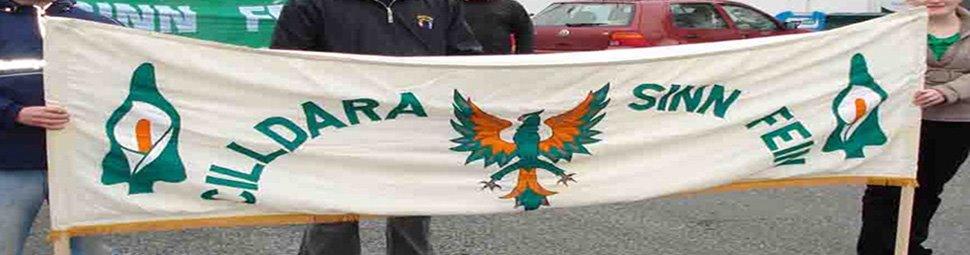
The colourful parade, with many banners and the new Republican Sinn Féin flags, marched in glorious sunshine along with the Pride of Éireann flute band from Portadown, Co Armagh and Seán Doyle, the piper from North Antrim.
At the memorial to Wolfe Tone proceedings were chaired by An Chomhairleoir Tomás Ó Curraoin, Gaillimh who spoke in Irish and English. He called on Veteran Republican Cecilia Conway, Kildare to lay the wreath on behalf of the Republican Movement.
The Chief Marshall then called the parade to Attention for the Dipping of the Flags, accompanied by a lament from the piper.
Tomás Ó Curraoin asked the National Graves Association representative, Peig Galligan, to say a few words and she spoke movingly of Liam Lynch and his comrades, done to death by Free State forces 90 years ago.
Tomás then introduced the President of Republican Sinn Féin, Des Dalton, Kildare to give the main oration.
Following the oration Tomás Ó Curraoin had harsh words to say regarding the (as usual) over-the-top policing of the parade and said that Republicans would not be intimidated or diverted from the task before them – the achievement of a 32-County Ireland.
While the parade was in Bodenstown, members of the 26-County police seized the proceeds of the Republican Sinn Féin bookstall in Sallins. The money was later returned to members of the Officer Board.

Oration by Des Dalton, President, Republican Sinn Féin at the grave of Patron Ruairí O Brádaigh, St Coman’s Cemetery, Roscommon, June 8

Speaking at the graveside of O’Donovan Rossa, Pearse restated the principles which had fired the soul and intellect of O’Donovan Rossa and restated the determination of his generation to take up the torch of freedom from Rossa and his generation: “I propose to you then that, here by the grave of this unrepentant Fenian, we renew our baptismal vows; that, here by the grave of this unconquered and unconquerable man, we ask of God, each one for himself, such unshakable purpose, such high and gallant courage, such unbreakable strength of soul as belonged to O’Donovan Rossa. Deliberately here we avow ourselves, as he avowed himself in the dock, Irishmen of one allegiance only. We of the Irish Volunteers, and you others who are associated with us in to-day’s task and duty, are bound together and must stand together henceforth in brotherly union for the achievement of the freedom of Ireland. And we know only one definition of freedom: it is Tone’s definition, it is Mitchel’s definition, it is Rossa’s definition. Let no man blaspheme the cause that the dead generations of Ireland served by giving it any other name and definition than their name and their definition.”
For Ruairí Ó Brádaigh there too was but one definition of Irish freedom. For him there was but one straight and true path leading to the All-Ireland Republic of Easter Week. We come here to mourn the loss of Ruairí but we also come to celebrate his long and rich life. It was a life marked by unselfish devotion to the cause of Irish freedom. It was a life set apart by his sense of duty, honour and the intellectual rigour that he brought to the Republican Movement. Indeed often would Ruairí quote these lines from Louisa May Alcott, which are inscribed on the headstone of the tireless champion of Republican prisoners and the working class Charlotte Despard: “I slept, and dreamed that life was beauty; I woke, and found that life was duty.” Coupled with all of this was Ruairí’s deep humanity. He was a man whose empathy and compassion for the downtrodden and oppressed knew no boundaries of race or creed.
In his biography of Ruairí, Professor Robert W. White of Indiana University, described Ruairí Ó Brádaigh’s life as: “…a window for understanding his generation of Irish Republicans and how they received the values of a previous generation and are transmitting those values to the next generation.” In his introduction to the same book, the journalist Ed Maloney described Ruairí as the “last, or one of the last Irish Republicans”. Whilst the tribute was well intentioned the case is quite different. It is because of the life’s work of Ruairí Ó Brádaigh that he is not the last Republican but has rather ensured the continuity of Irish Republicanism, passing on the torch to succeeding generations.
Ruairí Ó Brádaigh was a towering figure of Irish Republicanism in the latter half of the 20th Century. He came to embody the very essence of the Republican tradition, setting the very highest standards of commitment, duty, honour and loyalty to the cause of Irish freedom. Of a proud Republican heritage inherited from both his father Matt and his mother May, since 1950 he served at every level of the Republican Movement, and from 1956 took on the onerous responsibilities of national leadership with only a short intervals, up to the present day. Ruairí was a man of immense capability both as a politician and as a soldier. He holds the unique distinction of serving as President of Sinn Féin, Chief of Staff of the Irish Republican Army and from 1957 to 1961 as a TD, representing Longford/Westmeath.
At critical junctures in the history of the Republican Movement, Ruairí Ó Brádaigh, along with his close friend and comrade the late Dáithí Ó Conaill, manned the gap against the forces of reformism who sought to convert a revolutionary movement of national liberation into a mere constitutional political party, first in 1969/70 and once again in 1986. For Ruairí the essential principles of Irish freedom were clear and marked the political course to be followed. He dismissed any cult of the personality warning always of the inherent dangers of following merely the man or woman over the cause of Irish national independence. At a time when our sense of identity is being steadily eroded, when our people are discouraged from taking pride in their history or culture Ruairí Ó Brádaigh was a tireless champion of the Irish language viewing it as the cornerstone of our unique identity as a nation. Like Pádraig Mac Piarais he believed in an Ireland that was: ‘not only free but Gaelic as well; not only Gaelic but free as well’.
Gael go smior ab ea Ruairí. Óna chuid ama i gColáiste Mel is i gConamara, d’éirigh leis an teanga a thabhairt leis go han-líofa. Ar feadh a shaoil sheas sé go daingean le cúis na Gaeilge agus d’fhéach chuige go raibh Gaeilge ag an gclann ar fad.
Faraoir, le caoga bliain anuas d’aithin an meath a tháinig ar an teanga go háirithe an cúngú sna Gaeltachtaí is sa chóras oideachais. Tá an Ghaeilge i mbaol go mór mura dtugtar áit lárnach di in Éirinn. Mar atá faoi láthair níl áit do theangacha agus do chultúir ar nós na Gaeilge agus ár gcultúr Gaelach atá ag tachtadh ár muintire. Daoibhse atá in eagraíochtaí Gaeilge is gá daoibh an pictiúr mór seo, mar a deirtear, a aithint. Tá an Ghaeilge i mbaol, tá sí á ceil tar pháistí na tire, tá imeallú mór déanta uirthi.
The Irish Language has always been dear to Ruairí’s heart. He spoke it on every possible occasion and he saw to it that his children were all immersed in it. Unfortunately during the last 50 years the Irish language has been marginalized, neglected and downgraded in every possible way. The people of the Gaeltacht have been bullied by the politically-powerful and by international consumerism. This bullying has undermined their way of life. The neglect in the Education system now means that Irish is being denied to and hidden from 100’s of 1000’s of Irish children.
Who then is responsible for this obliteration of people’s languages and cultures worldwide, including our own Irish? There is no place for own heritage in this neo-liberal agenda, the EU won’t allow it, the two states, even the 26 counties’ Dept of Education, work against the Irish language. ‘Death by a 1000 cuts’ is the effective state policy on Irish whatever niceties may be uttered. To the Irish Language Organisations we say: Be very careful in your dealings with the Northern and Southern states. Stop cosying up to these false promises. They’re only trying to buy you off. 90% plus of the Irish people dearly love our language. They want it passed on propery to our children, they want it central to Irish life not neglected and marginalized. The Irish people need leadership, the Irish language agencies need to give sustained, determined leadership and we as Irish Republicans need to centrally retain our commitment to the Irish language and culture at all times.
As an Irish Republican he believed passionately in Theobald Wolfe Tone’s vision of substituting the denominations of Protestant, Catholic and Dissenter with the common name of Irish man and Irish woman. He played a leading role in formulating the Éire Nua proposals for a Four Province Federal Ireland, which was based on the principles of true decentralisation of decision making with full particatpory democracy involving all sections of the Irish people as trust founders of a New Ireland. Such a democratic template would provide the Unionist minority with a New Ireland with real political power and decision-making. He was among the Republican leaders who met representatives of loyalism and unionism as Feakle, Co Clare in 1974 and later strongly supported the MacBride/Boal talks, which were eventually sabotaged by a 26-County Government Minister. Such was Ruairí’s commitment to the principles of a non-sectarian and pluralist Ireland that he and Dáithí Ó Conaill stepped down from the positions of President and Vice President respectively of Sinn Féin when Éire Nua was dropped as a policy document to further the narrow political agenda of a reformist clique operating within the Republican Movement in the early 1980s.
For Ruairí Ó Brádaigh there could be no temporising on the issue of British Rule in Ireland. Drawing on the lessons of Irish history he recognised that it constituted the root cause of conflict and injustice for the Irish people. In opposing the 1998 Stormont Agreement he rightly viewed it as a flawed document serving only to copper-fasten British Rule while also institutionalising sectarianism, thereby further deepening the sectarian divide. Ruairí Ó Brádaigh’s analysis has since been bourne out by a number of independent studies which have shown an increase in sectarianism in the Six Counties in the years since 1998. The economically and politically oppressed and partitioned Ireland of today is far removed from the vision of a New Ireland, which inspired Irish Republicans such as Ruairí Ó Brádaigh.
Standing by Ruairí’s graveside we can only truly honour him by turning our eyes to the future, by pledging ourselves to once more take up the fight for a New Ireland. Today our country is being assailed by the twin imperialisms of British military and political occupation and the economic and social oppression of the EU/ECB and IMF. These represent the old and new imperialisms, representing a threat to the very existence of the historic Irish Nation. In the Six Counties political repression remains the norm and the very fact that there remain political prisoners in Maghaberry, the internment without trial of veteran Republican Martin Corey and until recently of Marian Price, the presence of an armed Colonial police force using the same methods of repression, drawing on the same draconian laws to enforce the writ of the British Government all point to the abnormality of the Six County State. British Rule in Ireland will never be wither normal or acceptable and the lesson of Irish history remains as Ruairí continually pointed out: as along as there is a British military and political presence in Ireland there will always be a section of the Irish people determined to resist it. In the 26-County State our people are being robbed of the very markers of a civilised society, the ability to care for our sick and old, to educate our young and to provide for those on the economic margins of society. All of this is being imposed on our people in order to prop up the undemocratic EU superstate and its baking system.
The Irish people it seems are merely fodder to be sacrificed on the high alter of EU finance capitalism. But not only are our people plundered financially but also culturally. It seems that the denizens of Leinster House, Stormont, Westminster and Brussels are intent on robbing us of our identity as a separate people and nation. Writing recently in the Sunday Business Post, Tom McGurk wrote that because the Irish people are being thought that it is wrong to take pride in our history, of resistance, our distinct culture and identity, today they are being denied the very tools of a strong sense of national identity required to stand up to EU Troika in contrast to people’s across Europe who have heroically defended themselves and their societies from the grip of the financial and banking elites. With Thomas Davis we believe: “This country of ours is no sand bank, thrown up by some recent caprice of earth. It is an ancient land, honoured in the archives of civilisation.”  The Irish nation is not bound by the artificial borders of the two partition states, The philosopher Dr Mathew O’Donnell writes that nations rather than states, which are simply units of political organisation, bring people together: “For people are not brought together by a state; the state is the subsequent organisation of people who already posses some kind of unity…It is with the nation that one’s loyalty lies. There is no disowning it, no alternative to it. There should be a feeling for the nation, for it is one’s own people. This is the origin for the effective element in patriotism.”
In the early 1890s the Irish Revolution began in earnest, speaking in 1892 the founder of Conradh na Gaelige Dubhghlas de Híde spoke of the need to reverse the process of anglicising Ireland:  “When we speak of 'The Necessity for De-Anglicising the Irish Nation', we mean it, not as a protest against imitating what is best in the English people, for that would be absurd, but rather to show the folly of neglecting what is Irish, and hastening to adopt, pell-mell, and indiscriminately, everything that is English, simply because it is English.”
He went to set out why we as a people needed to reconnect with our own distinct cultural identity if we were to prosper: “I would earnestly appeal to every one, whether Unionist or Nationalist, who wishes to see the Irish nation produce its best -- surely whatever our politics are we all wish that -- to set his face against this constant running to England for our books, literature, music, games, fashions, and ideas. I appeal to every one whatever his politics -- for this is no political matter -- to do his best to help the Irish race to develop in future upon Irish lines, even at the risk of encouraging national aspirations, because upon Irish lines alone can the Irish race once more become what it was of yore -- one of the most original, artistic, literary, and charming peoples of Europe.” As the centenary of the 1916 Rising draws near we have the opportunity once again to awaken the national consciousness to our possibilities as a people and the high ideals which have in the past inspired us to greater things and a vision of a New and better Ireland. As we approach the centenary of the 1916 Rising a battle has commenced for the hearts and minds of the Irish people.
The legacy as well as the essential message of 1916 is at stake for this and future generations. The resources of both partitionist states are being employed in order to sanitise our history to the point that it has been robbed of any meaning. Equivalence is being made between the forces of occupation and the independence movement that no self-respecting nation would contemplate. Does France commemorate the Vichy policemen or Norway its Quislings who collaborated with German occupation forces? The 1916 Rising for Irish Republicans is not only an important moment in our history but a beacon to light our way forward. It is an event that not only continues to occupy a central place in our history but also remains relevant due to the simple fact that it remains unfinished business.
The 1916 Proclamation sets out clearly the principles upon which the All-Ireland Republic should rest. It takes no great examination to see that both the Six and 26-County states fall far short of the definition of freedom and democracy set by the men and women of 1916.  This would be and remains the abiding message of Ruairí Ó Brádaigh.
In carrying on the work to which Ruairí dedicated his adult life we must bring to it the same high standards, the same commitment to truth and honour which guided him. We must never lose sight of the high idealism of 1916 because it will always speak to us of a New and better Ireland and with it the possibility of revolutionary social, political and economic change. and should note well the words of Brian Ó hUiginn: “Keep close to them on the road they walked without flinching, the road whose signposts, as Liam Mellows said, are unmistakable, the road of truth and honour and earnestness and courage, the road of no wavering, of no compromise with wrong, of no surrender – the only road that leads to the freedom and happiness of the indivisible Republic of Ireland.”
As we turn from this place we remember with pride our fallen chieftain, our Fenian Chief (as Desmond Ryan described James Stephens) I think it is appropriate to conclude with some words penned by John Fisher Murray To the Memory of Thomas Davis:
“A spark of his celestial fire, The God of freemen struck from thee; Made thee to spurn each low desire, Nor bend the uncompromising knee; Made thee to vow thy live to rive with ceaseless tug, th’ oppressor’s chain with lyre, with pen, with pen, with sword, to strive for thy dear land – nor strive in vain.
How hapless is our country’s fate – If heaven in pity to us send, Like thee, one glorious, good and great – to guide, instruct us, and amend: How soon thy honoured life is o’er – Soon Heaven demandeth thee again; We grope on darkling as before, And fear lest thou hast died in vain.
In vain – no never! O’er thy grave, Thy spirit dwelleth in the air; Thy passionate love, thy prupose brave, Thy hope assured, thy promise fair. Generous and wise, farerwell! – Forego tears for the glorious dead and gone; His tears if his, still flow for slaves and cowards living on.
To Patsy, Mait, Ruairí Óg, Conor, Deirdre, Ethne and Colm,his grandchildren and great-grandchild we extend our deepest sympathies and our gratitute to you and the extended Ó Brádaigh family for the life of Ruairí and his unparalled contribution to the cause of a free Ireland. Ar dheis dé go raibh a anam dílis.
Ruairí Ó Brádaigh a towering figure of Irish Republicanism


Statement by Des Dalton, President, Republican Sinn Féin, on the death on June 5 of Ruairí Ó Brádaigh, Patron and former President, Republican Sinn Féin.

Ruairí Ó Brádaigh was a towering figure of Irish Republicanism in the latter half of the 20th century. He came to embody the very essence of the Republican tradition, setting the very highest standards of commitment, duty, honour and loyalty to the cause of Irish freedom.
Since 1950 he served at every level of the Republican Movement, and from 1956 took on the onerous responsibilities of national leadership with only a short interval, up to the present day. Ruairí was a man of immense capability both as a politician and as a soldier. He holds the unique distinction of serving as President of Sinn Féin, Chief of Staff of the Irish Republican Army and from 1957 to 1961 as a TD, representing Longford/Westmeath.
At critical junctures in the history of the Republican Movement, Ruairí Ó Brádaigh, along with his close friend and comrade, the late Dáithí Ó Conaill, manned the gap against the forces of reformism who sought to convert a revolutionary movement of national liberation into a mere constitutional political party, first in 1969/70 and once again in 1986.
For Ruairí the essential principles of Irish freedom were clear and marked the political course to be followed. He dismissed any cult of the personality, warning always of the inherent dangers of following merely the man or woman over the cause of Irish national independence. At a time when our sense of identity is being steadily eroded, when our people are discouraged from taking pride in their history or culture Ruairí Ó Brádaigh was a tireless champion of the Irish language viewing it as the cornerstone of our unique identity as a nation.
Like Pádraig Mac Piarais he believed in an Ireland that was: not only free but Gaelic as well; not only Gaelic but free as well.
As an Irish Republican he believed passionately in Theobald Wolfe Tones vision of substituting the denominations of Protestant, Catholic and Dissenter with the common name of Irish man and Irish woman.
He played a leading role in formulating the ÉIRE NUA proposals for a four-province Federal Ireland, which was based on the principles of true decentralisation of decision-making with full particatpory democracy involving all sections of the Irish people as trust founders of a New Ireland. Such a democratic template would provide the Unionist minority with a New Ireland with real political power and decision-making. He was among the Republican leaders who met representatives of loyalism and unionism at Feakle, Co Clare in 1974 and later strongly supported the MacBride/Boal talks, which were eventually sabotaged by a 26-County Government Minister.
Such was Ruairís commitment to the principles of a non-sectarian and pluralist Ireland that he and Dáithí Ó Conaill stepped down from the positions of President and Vice President respectively of Sinn Féin when ÉIRE NUA was dropped as a policy document to further the agenda of a reformist clique operating within the Republican Movement in the early 1980s.
For Ruairí Ó Brádaigh there could be no temporising on the issue of British rule in Ireland. Drawing on the lessons of Irish history he recognised that it constituted the root cause of conflict and injustice for the Irish people. In opposing the 1998 Stormont Agreement he rightly viewed it as a flawed document serving only to copper-fasten British Rule while also institutionalising sectarianism, thereby further deepening the sectarian divide. Ruairí Ó Brádaighs analysis has since been bourne out by a number of independent studies which have shown an increase in sectarianism in the Six Counties in the years since 1998. The economically and politically oppressed and partitioned Ireland is far removed from the vision of a New Ireland, which inspired Irish Republicans such as Ruairí Ó Brádaigh.
In an introduction to the biography of Ruairí Ó Brádaigh written by Professor Robert White, the journalist Ed Moloney described Ruairí as the last, or one of the last Irish Republicans. Whilst the tribute was well intentioned the case is quite different. It is because of the lifes work of Ruairí Ó Brádaigh that he is not the last Republican but has rather ensured the continuity of Irish Republicanism, passing on the torch to succeeding generations.
We in Republican Sinn Féin are proud to remember him as our President and later our Patron, as a man of great intellect, coupled with great humanity and empathy for the oppressed both in Ireland and internationally. We salute his memory and pledge our resolve to honour him by continuing his work, guided by the same principles and maintaining the same high standards of integrity, truth and that marked Ruairí Ó Brádaigh as man and patriot. We extend our profound sympathies to his wife Patsy, and the Ó Brádaigh family. Ar dheis dé go raibh a anam dílis.

Biography: Ruairí Ó Brádaigh

1932: Born in Longford.
1950: Joined Sinn Féin
1951: Joined the Irish Republican Army.
1955: OC Arborfield arms raid.
1956: 2 o/c Teeling Column, South Fermanagh.
1957: Elected in Longford-Westmeath Sinn Féin TD to All-Ireland parliament.
1958: Escaped with Dáithí Ó Conaill from Curragh Camp.
1958-9 and 1960-62: IRA Chief of Staff.
1966: Republican candidate in Fermanagh-South Tyrone.
1970-83: President of Sinn Féin.
1987 to date: President of Republican Sinn Féin.
2009-2013: Patron of Republican Sinn Féin.
Married to Patsy, six children: Mait, Ruairí Óg, Conor, Deirdre, Ethne, Colm, grandchildren and great-grandchild. He was a secondary teacher by profession.

Wolfe Tone Commemoration

Wolfe Tone Commemoration

Bodenstwon, 2.30pm

Sunday, June 16

Sallins, Co Kildare

Bus: from Ashton Quay, Dublin, 12.45pm; Táille: € 10


We must never lose sight of the high idealism of 1916

Speaking in Derry and Drumboe, Co Donegal on Easter Sunday, March 31 the President of Republican Sinn Féin Des Dalton said:

Every year Irish Republican gather at monuments and graves throughout Ireland and around the world both to commemorate the heroic deeds of the past but also to rededicate themselves to the essential work of the present which is to bring to victory the cause for which that generation like those before and since: “weighed so little what they gave” in the words of Yeats. The 1916 Rising gave us our charter of freedom and it serves the cornerstone of everything that we do as Irish Republicans. To regard 1916 as merely an historical event would be to do a disservice to all that sacrifice. We can only properly honour the memory of those who have gone before by recognising that their cause and ideals remain for us to realise.

In commemorating 1916 we also remember the men and women who made the supreme sacrifice throughout the preceding and succeeding generations. Ninety years ago at Drumboe four more names were inscribed on Ireland’s Roll of Honour. Charlie Daly, Tim O’Sullivan and Dan Enright came to join the fight with their comrades in Ulster and along with Sean Larkin of Derry died in defence of the full freedom of Ireland. Daly, Larkin, O’Sullivan and Enright were in the words of Peadar O’Donnell among that brave band of men and women who: “milled the stampede of 1922.” These men and women fought to preserve the All-Ireland Republic from the forces of reaction, forces who sought to undo the work of the ‘Four Glorious Years’ when the All-Ireland Republic became a functioning reality. The Counter-Revolution of 1922-23 was a war between the forces of All-Ireland democracy and those who were willing tools of British imperialism; the present failed partitionist system is its legacy.

Drumboe, Ballyseedy, Countess Bridge and other sites throughout Ireland are names, which ring with infamy. The dark deeds carried out in these places should serve as a salutary lesson to those who think it possible to temporise or compromise on the principle of Irish freedom and the depths to which those who collaborate with British rule can sink. Brian Ó hUiginn writes: “The lesson of 1922, of all the years before it and all the years since is that when you seek help from an enemy invader against your own, you become his contemptible slave. He will degrade you and drive you to do deeds that your people will remember with shame for all the years to be.” It is a lesson that should be noted by those who today sit comfortably in Stormont and Leinster House.

As we approach the centenary of the 1916 Rising a battle has commenced for the hearts and minds of the Irish people. The legacy as well as the essential message of 1916 is at stake for this and future generations. The resources of both partitionist states are being employed in order to sanitise our history to the point that it has been robbed of any meaning. Equivalence is being made between the forces of occupation and the independence movement that no self-respecting nation would contemplate. Does France commemorate the Vichy policemen or Norway its Quislings who collaborated with German occupation forces? The 1916 Rising for Irish Republicans is not only an important moment in our history but a beacon to light our way forward. It is an event that not only continues to occupy a central place in our history but also remains relevant due to the simple fact that it remains unfinished business. The 1916 Proclamation sets out clearly the principles upon which the All-Ireland Republic should rest. It takes no great examination to see that both the Six and 26-County states fall far short of the definition of freedom and democracy set by the men and women of 1916. We would do well to remember the words of Pearse: “We know only one definition of freedom: it is Tone’s definition, it is Mitchel’s definition, it is Rossa’s definition. Let no man blaspheme the cause that the dead generations of Ireland served by giving it any other name and definition than their name and their definition.” If 1916 and all that it represents was of no relevance to the Ireland of today the 26-County Administration, the British Government and its surrogates in Stormont could quite happily ignore it. Instead they are attempting to erase from the public mind any notion of Ireland as a nation by hijacking our history, robbing this and future generations of their identity, even the name Ireland has now been replaced in the official lexicon by the meaningless term “the island” in a blatant attempt to deny the essential unity of the Irish Nation. Instead loyalty to the state is expected to replace the natural sense of allegiance and identification people feel towards their nation.  The philosopher Dr Mathew O’Donnell writes that nations rather than states, which are simply units of political organisation, bring people together: “For people are not brought together by a state; the state is the subsequent organisation of people who already posses some kind of unity…It is with the nation that one’s loyalty lies. There is no disowning it, no alternative to it. There should be a feeling for the nation, for it is one’s own people. This is the origin for the effective element in patriotism.” Dr O’Donnell warns of the dangers of substituting state for nation: “ An unduly emotional attachment to the state – the organising coercing element – will surely lead to totalitarianism, expansionism, militarism. And an unduly detached critical attitude to the nation could lead to an exaggerated cosmopolitanism, rootlessness, and in the long run, a general impoverishment of the spirit through the loss of the sense of belonging. If humanity is reduced to pure individuality it is a poor and stunted thing.”  

Like Thomas Davis we believe: “This country of ours is no sand bank, thrown up by some recent caprice of earth. It is an ancient land, honoured in the archives of civilisation.” We must never lose sight of the high idealism of 1916 because it will always speak to us of a New and better Ireland and with it the possibility of revolutionary social, political and economic change.

Today we see all too clearly the evidence of the failure of both paritionist states. In the 26 Counties once more our young people are being exported while the political and economic elites wage a war of attrition and economic terrorism on the people of the country. The language used by 26-County County ministers resonates of a Victorian morality speaking almost in terms of a “deserving and undeserving poor.’ They are collaborating with the new imperialists of the EU/ECB and IMF Troika in the their attempt to economically enslave the people of the 26 Counties. In the Six Counties the evidence of the old imperialism of British Rule is all too evident for those who wish to see. Despite the protestations of the Stormont regime and its apologists in the media the internment without trial of Martin Corey and the continued imprisonment of Marian Price expose the Six-County State as an undemocratic and abnormal political entity. In July last year the then British Secretary of State Owen Paterson was willing to subvert his state’s own judicial process in order to keep Martin Corey in jail. Forty-one years after the introduction of internment in the Six Counties it is once more being employed as a means of silencing Irish Republicans. What has happened to Martin Corey constitutes not only an attack on Martin’s human and civil rights but are an attack on the human and civil rights of all people within the Six Counties. The ongoing struggle by Republican POWs in Maghaberry prison are yet another indicator of the abnormality of the Six-County State. We extend them our greetings and pledge them our continued solidarity. On top of this while the Provos mouth emply words of protest about the effects of austerity in the 26 Counties they along with the DUP willingly implement cuts in health, education and other esetnial services across the Six Counties.

The past number of months has underlined the abnormality of the Six-County state and its inherent sectarianism. On December 3 Belfast City Council voted to end the daily flying of the ‘Union Jack’ flag over Belfast City Hall. Instead a coalition comprising of the Provisionals, the SDLP and the Alliance voted to fly the ‘Union Jack’ on 17 designated days. This unleashed an orgy of loyalist rioting and protests across the Six Counties but particularly focussed on East Belfast. In contrast to the heavy handed treatment meted out by the RUC/PSNI to Republicans and nationalists who have engaged in peaceful protests the loyalists riots were met with only token opposition from the RUC/PSNI. Indeed Republicans attending the annual Bloody Sunday commemorative march in Derry on January 27 witnessed the RUC/PSNI helping loyalists to erect loyalists flags in the city. Compare this with the Republicans who have been jailed for simply participating in a peaceful protest march highlighting the ongoing internment of Martin Corey. On the top of this comes the call from the Provisionals for a ‘Border Poll’ on Irish unity. It is important that all of this is viewed in context in order to understand what is going on here. With the securing of British rule the big constitutional questions have been removed from the political agenda and in their place instead we find the tribal and sectarian games of one-upmanship of the two sectarian power blocs at Stormont led by the Provos and the DUP. In his Irish News column on December 15 Patrick Murphy described Stormont as: “…a sectarian carve-up of limited autonomy…It is designed to cater for, rather than counter, sectarian differences.” The Provisionals are quite happy to tout the vote in Belfast City Council as a victory, but over whom? British Rule is firmly entrenched administered and policed by the Provos and their camp followers, internment with-out trial and the attempted criminalisation of Republican prisoners goes on, political policing and repression is the daily experience of nationalist communities across the Six Counties, little wonder then the Provos would attempt to reduce the issue of Irish freedom to a question of flags and symbols. By doing so they hope to distract from their abandonment of even a basic nationalist, let alone, a Republican position. In 2009 Vincent Browne in his nightly TV3 programme put it clearly. He said in effect that the nationalist view had been rejected and the unionist position had been accepted. The nationalist standpoint was that the people of Ireland as a whole should determine the future of Ireland. He continued: “The Unionist position was that the majority in the Six Counties should decide the future. We have all become unionists.” Having abandoned Republicanism the Provos have embraced sectarianism as the means to consolidate their power base. As Patrick Murphy points out: “With few modern writers, philosophers or even poets saying much about the Irish nation, nationalism in the north has degenerated into what we might call quantitative sectarianism. It uses a sectarian inch tape to quantify the frequency of flag flying, the number of Catholics in the census results and the volume of music from Orange bands. Unionism is delighted to hold the other end of the British-made tape.” It is working class Protestants now who are the enemy not the British Government as establishment Provo leaders queue up to shake hands with the Queen of England while at the same time stoking the flames of sectarian conflict. The nationalist community within the Six Counties have rightly not allowed themselves to be sucked into the naked sectarian violence despite blatant attempts to provoke a response with attacks on nationalist areas. Republican Sinn Féin correctly refused to rise to the bate of Unionist stooge Willie Frazer when a loyalist protest at Leinster House was mooted. Instead leadership is required in keeping the focus on the core issue, which is partition and British rule in Ireland. The Provo’s sectarian alter ego in the DUP likewise is playing the sectarian card in order to bolster and increase their power.

In January the Provos called for a ‘Border Poll’, again more of the smoke and mirrors designed to give their supporters the illusion of actually doing something to end partition while masking the reality that they have been absorbed wholesale into the machinery of British rule. By rejecting the very notion of an historic Irish nation and swallowing the idea that British generated sectarianism is a conflict between two nationalities the Provos have undermined any effective argument for Irish unity, reducing their case to one of pure economics. In the late 1940s having lost power after 16 years Fianna Fáil latched onto the issue of partition using the Anti-Partition League as a vehicle to consolidate their base and rebuild support. The waving of the green flag and the platitudes about the ‘fourth green field’ were their electoral stock-in-trade. Now the Provos are playing a similar game. As Patrick Murphy puts it: “…the proposed border poll is cleaver electioneering for more important polls north and south.” For true Republicans the attempts by the Provos to besmirch Republicanism with sectarianism is as reprehensible as those who would try to link it with criminality.

Another and serious threat to Republicanism is that posed by the gangs operating under the banner of Republicanism who are engaging in activities which sully the proud and honoured name of Irish Republicanism. Elements within the media are more than happy to promote these groupings as representative of the Republican tradition hoping that in the process they will discredit and delegitimise Republicanism in the eyes of the Irish people. the pseudo-Republican groupings that take money from the drug dealers are no less parasitical than the drug dealers themselves. In many ways they are worse in that they leech from the communities they purport to defend – in effect they are drug dealers by proxy with the added insult of sullying the noble name of Republicanism in doing so. These pseudo- gangs masquerading as Republicans have nothing to contribute to the struggle for a free Ireland and should disband now.

The duty to halt this slide lies with those who claim the title deeds of Republicanism.  We have a bounden duty to hold out against this hijacking of the Republican ideal; we must lead by example in ensuring that authentic Irish Republicanism continues to live in the hearts of the Irish people. Republican Sinn Féin must maintain its organisational integrity and thereby ensure that we provide a focal point for those seeking a true and credible Republican alternative.

On June 14 and 15 Republican Sinn Féin will be holding an Anti-Imperialist Forum in Belfast as an Irish Republican Alternative to the G8 summit taking place in Co Fermanagh. The forum will be a platform for discussion and debate for anti-imperialist activists from Ireland and abroad to discuss alternatives to the imperialist world order as represented by the G8 group of states. Delegates from abroad will provide an international perspective and allow Ireland’s struggle against the twin imperialisms to be viewed in its international context. We are calling on those interested in contributing to the debate on a New Ireland to join us in Belfast and begin the process of building a network of solidarity among all peoples around the world striving a new and better world. Culminating with the annual Wolfe Tone commemoration in Bodenstown on June 16 it will be truly a weekend suffused with the spirit of anti-imperialism.

One has only to look back at the course of Irish history to learn that as long as Britain continues to deny Ireland and her people their right unfettered nationhood that denial will be met with resistance. This response to British Rule has proven to be an iron law of Irish history, denying its reality will not make it go away. We believe that only by fully engaging with the root cause of conflict, which is partition and continued British occupation, can there be any prospect of a just and lasting settlement. A public declaration of intent by the British Government to withdraw militarily and politically from Ireland will create the space necessary to build a New Ireland for all sections of the Irish people, Protestant, Catholic and Dissenter. We believe that Éire Nua coupled with our social and economic programme Saol Nua contains the basis for a truly pluralist 32-County Federal Democratic Socialist Republic. We resolutely and unapologetically take our stand on the Proclamation of 1916: We declare the right of the people of Ireland to the ownership of Ireland, and to the unfettered control of Irish destinies, to be sovereign and indefeasible. The long usurpation of that right by a foreign people and government has not extinguished the right, nor can it ever be extinguished except by the destruction of the Irish people.” Our proposals contained in Towards A Peaceful Ireland provides for the election of a 32-County Constituent Assembly to draft an All-Ireland Constitution, providing the mechanism by which the process of creating a New Ireland can begin.

We turn from here determined to continue on the long straight path to a Free Ireland. History teaches us that there are no short cuts on that road and only by achieving the goal of the All-Ireland Republic of Easter Week can we fully realise our full potential as a free people, taking our place rightfully among the nations of the earth.

We must ensure as a political movment that we are worthy of the task entrusted to us and should note well the words of Brian Ó hUiginn: “Keep close to them on the road they walked without flinching, the road whose signposts, as Liam Mellows said, are unmistakable, the road of truth and honour and earnestness and courage, the road of no wavering, of no compromise with wrong, of no surrender – the only road that leads to the freedom and happiness of the indivisible Republic of Ireland.”

"We of Republican Sinn Féin are the nucleus, which represents what Emmet represented,
the soul of Ireland,the prophetic shock minority, those who are neither purchased nor intimidated."

Republican Sinn Féin Kildare © 2008. Powered by Republican Sinn Féin: 223 Parnell Street, Dublin /// 229 Falls Road, Belfast .

Webmaster