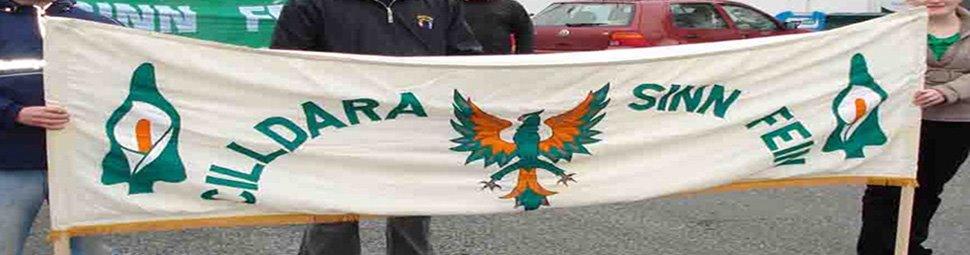
Cill Dara Shinn Féin Poblachtach

British and 26-County States target Republican Sinn Féin

The arrest and charging of the President of Republican Sinn Féin Des Dalton and Vice President Fergal Moore in Lurgan, with participation in a protest march on July 6 is clearly the latest in a campaign to silence Republican Sinn Féin by both the British and 26-County States.

The march in Lurgan, organised by Republican Sinn Féin on January 23, was held as part of campaign calling for the release of veteran Republican Martin Corey – interned without trial since April 2010 - as well as to protest at the non-implementation of the August 12, 2010 Agreement in Maghaberry Prison.

On February 16 the RUC/PSNI issued a letter to the President of Republican Sinn Féin accusing him of participating in an “illegal march” in Lurgan on January 23.

In May Republican Sinn Féin Ard Chomhairle member Cait Trainor (Armagh), along with a member of the Thomas Harte Cumann in Lurgan Sean Maloney, was arrested and charged with a political interview given to Channel Four News in September 2010

During the protests in Dublin against the visit by the Queen of England in May the Secretary of Dublin Comhairle Ceantair Diarmuid Ó Dúbhghlais and another member of Republican Sinn Féin, were arrested solely for their participation in the protests. Diarmuid Ó Dúbhghlais was pictured by the media holding aloft the National Flag at the time of his arrest.

On June 30 the home of the newly appointed National Publicity Officer of Republican Sinn Féin Geraldine McNamara in Tipperary was raided by the 26-County Special Branch who refused to let her read the search warrant and her mobile phones were taken. Again this was act intended to silence and intimidate Republican Sinn Féin members and supporters.

The pattern of harassment continued with the arrest of the organisation’s President and Vice President on July 6. The opposition of the RUC/PSNI and the Public Prosecution Services (PPS) to bail for both men was clearly an attempt to intern Des Dalton and Fergal Moore by remand.

On July 8 Cáit Trainor was once again arrested at her home in Armagh and charged with breaking her bail conditions, with attending the picket on Lurgan RUC station on the night of Des Dalton’s arrest. She was taken straight to Craigavon courthouse

It is evident that the undiluted message of revolutionary Irish Republicanism delivered by Republican Sinn Féin is feared by Westminster, Stormont and Leinster House. It is a message and a cause whose roots lie deep within the hearts of Irish people. The age-old tactic, of locking up the messenger and silencing the message and the very idea of Irish freedom, has failed in the past and history teaches us will fail again today and in the future.

Bookmark and Share

Carlow remembers the hunger strikers

Carlow Republican Sinn Féin held a very successful picket at the Liberty Tree 1798 monument in Carlow Town today (Saturday July 9) from 1.00pm to 2.30pm. The picket was held to commemorate the 30th anniversary of the 1981 Hunger Strike in the H Blocks of Long Kesh in which Bobby Sands and nine other Republican prisoners died. The picket was also to highlight the present campaign of the Republican prisoners in Maghaberry prison for the right to political status.

During the protest leaflets were distributed explaining about the protest in Maghaberry prison as well as the plight of veteran Republican Martin Corey who is at present interned without trial in Maghaberry prison where he has been held since April of last year.

The picket was addressed by the Athy based President of Republican Sinn Féin Des Dalton who said that the events of 1981 were not merely a matter of history: “Today young Irishmen in Maghaberry prison are engaged in the same struggle against the same enemy on the same principle of political status. Like Bobby Sands and his comrades the present Republican prisoners are resisting the attempts of the British Government and its surrogate at Stormont to criminalise the historic and noble struggle for Irish freedom.”

Bookmark and Share

Republican Sinn Féin President arrested

Des Dalton, President of Republican Sinn Féin was arrested outside Lurgan, Co Armagh on tonight, Wednesday, July 6 at around 8pm. He was on his way to speak at a protest march in support of the Maghaberry POWs in the Drumbeg Estate in Lurgan.

He was informed by the RUC/PSNI that he was being arrested in connection with an ‘illegal march’. The march in question was held in Belfast on January 23 in support of the Republican POWs in Maghaberry jail and in particular drawing attention to the case of Martin Corey, whose licence was revoked last year without any reason being given.

Bookmark and Share

Carlow remembers the hunger strikers

The Tony Ruane/Myles Shevlin Cumann of Republican Sinn Féin in Carlow will be marking the 30th anniversary of the 1981 H Block hunger strikes with a picket in Carlow Town on Saturday July 9. The picket will also be in solidarity with the Republican prisoners in Maghaberry Prison Co Antrim who have recommenced a protest in defence of their right to political status.

The picket will take place at the Liberty Tree 1798 monument from 1.pm to 2pm.

Bookmark and Share

British withdrawal only basis for a New Ireland

Speaking at a commemoration marking the 90th anniversary of the murder by British forces of John and Thomas O’Reilly, Peter McGennity and Patrick Quinn in Killeen, Co Armagh the President of Republican Sinn Féin Des Dalton said:

“The nationalist people of the Six Counties have long experienced at first hand the terror and brutality of the British state. Gathering here to commemorate the murders of four soldiers of Oglaigh na hEireann at the hands of pro-British forces we are reminded that such dark deeds have been repeated time and again over the course of the last 90 years in the Six Occupied Counties.

“In the early hours of July 6 1921 – only four days before the truce with British forces – a British murder squad called to the homes of brothers John and Thomas O’Reilly, Peter McGennity and Patrick Quinn. All of them were volunteers in the First Northern Division of the IRA. The O’Reillys and Peter McGennity were driven a short distance from the McGennity house to the spot where they were shot dead. According to the Newry Reporter three quarters of an hour later the same murder gang raided the McQuaid home in Newry where Patrick Quinn was staying. Despite making a valiant attempt to escape Patrick Quinn was gunned down.

“Despite the fact that a sister of Peter McGennity told a British Military Inquiry that she could identify one of the murderers having seen him enter the British military barracks no was ever arrested or charged with the murders.

“The year 1921 had seen martial law declared in many parts of Ireland, habeas corpus was suspended while British forces engaged in a campaign of terror and murder. In 1920 the Lord Mayors of Cork and Limerick were murdered. In 1921 alone 322 young men were murdered in what have been called “official reprisals”.

“In March of the following year six members of the McMahon family along with Edward McKinney were murdered in Belfast by British forces. The following week saw another five nationalists murdered by the British Colonial police in the Arnon St massacre also in Belfast. Between June 1920 and July 1922 267 nationalist would be killed as a result of a British inspired sectarian pogrom. Dorothy Macardle in her authoritive history of that revolutionary decade ‘The Irish Republic’ wrote: ‘By June 18th, 1922, it was calculated, the total casualties since June 21st, 1920, were 1,766 wounded and 428 killed. The number driven from their homes, the ultimate triumph of the pogrom, was about 23,000. This work was carried out by the Specials and the mob. The British troops stationed throughout the towns of the Six Counties did not interfere.’

“During the current phase of the war against British rule in Ireland the British state has used similar methods in order to strike fear into the hearts of the nationalist community. In October 1976 in Whitecross, Co Armagh, a British-backed loyalist death-squad murdered six nationalists from two families, three from the Reavy family – one of whom died shortly after the attacks - and three from the O’Dowd family. The murder gang included members of the RUC and the British Army’s notorious UDR.

“The methods and policy of British Rule in Ireland does not change with time. Britain has always maintained its grip on Ireland through brutality and terror and has not taken anything off the table today in terms of the methods it will use to control the nationalist population.

“The 1998 Stormont Agreement was sold to the nationalist people of the Six Counties as providing a stepping-stone to a united and free Ireland. The Stormont Assembly is an obstacle on the road to a free Ireland not a stepping-stone.

“The events in the Short Strand in Belfast on June 21 and 22 along with the riots there over this weekend (July 1,2,3) and the response of the British state tell us that nothing has changed. Despite the admission of the RUC/PSNI that the attacks on the nationalist people of the Short Stand were “orchestrated” by the UVF, the first arrests were of two nationalists and within a day the Stormont First Minister Peter Robinson was sitting down to talk to the UVF.

“The report of British Police Ombudsman Al Hutchinson into the murder of six nationalists in Loughinisland Co Down by a British directed loyalist death-squad in 1994 again exposes the true face of British Rule in Ireland. Hutchinson chose to ignore obvious evidence of collusion between loyalist death-squads and British Crown forces in his report. Again the British State protecting its own.

“Thirty years after the heroic sacrifice of Bobby Sands and his nine comrades in the H Blocks of Long Kesh Republican prisoners in Maghaberry prison are again embarking on a protest to uphold their right to political status and deny the attempt of the British Government and its surrogate regime in Stormont to criminalise the struggle for Irish Freedom. On June 30 they announced a return to protest as a result of the Stormont Justice Minister David Ford reneging on the independently mediated Agreement reached in August. We salute them and pledge them our activism and energy in support of their struggle. It is no less than our duty as Irish Republicans.

“Irish history has shown that there can be no lasting peace or settlement in Ireland as long as the British state continues to occupy Ireland. Each succeeding generation has shown willingness and ability to resist British rule and the present generation is no different in this regard. It is only by a full and total withdrawal of British military and political interference in Ireland can there be the basis for building a New Ireland.

“Republican Sinn Féin confidently puts forward Éire Nua as the only credible alternative to the two failed partitonst states. With its democratic check and balances and provision for local decision making within a free federal Ireland all sections of the Irish people will have a stake in the New Ireland.

“We honour the memory of four brave volunteers of the army of the All-Ireland Republic - the IRA - who gave their lives so that the Irish Nation might live. Our most fitting monument to them will be the re-establishment of that All-Ireland Republic. It is only then that we as a nation can march ‘to the dawn light of freedom.’”

An Phoblacht Abú

Bookmark and Share

Loughinisland Report shows British policing in Ireland has not changed

Statement by the President of Republican Sinn Féin Des Dalton

The report by British Police Ombudsman Al Hutchinson into the murder of six people in Loughinisland, Co Down in 1994 by a British-backed Loyalist death-squad confirms that the nature of British rule in Ireland has not changed. Al Hutchinson’s report fails the crucial test of the definition of collusion he uses in coming to the conclusion that there was no collusion between loyalists and British Crown forces. The very narrow definition used by Hutchinson is in contrast to the very broad, clear and concise definition used by retired Canadian Judge Peter Corey in his inquiry into British and 26-County state collusion. Corey stated: “they [The two states] must not act collusively by ignoring or turning a blind eye to the wrongful acts of their servants or agents”. It is clear that in this case that is precisely what that RUC/PSNI did in their so-called investigation of the murder of these six people.

The leopard does not change his spots and this case shines a spotlight on the never changing face of British rule and policing as experienced by the nationalists people of the Six Counties.

Bookmark and Share

Republican Sinn Féin President opens new Blog

The President of Republican Sinn Féin Des Dalton opened a new blogspot on June 23. In it he says he intends to use the blog to explain and promote “a view of Ireland today and how we can build a New Ireland and restore the All-Ireland Republic promised by the proclamation of 1916. A real Republic shaped by the Irish people themselves rather than an act of Westminster or the IMF or the ECB.”

The blog can be found at: http://thesingingflamedesdalton.blogspot.com


Bookmark and Share

A 32-County free Ireland is only fitting monument to hunger strikers

Speaking at Republican Sinn Féin’s commemoration of the 30th anniversary of the 1981 hunger strikes in the H Blocks of Long Kesh, which was held at the Ashe Memorial Hall in Tralee Co Kerry on Saturday June 4 the President of Republican Sinn Féin Des Dalton said:

Thirty years ago ten young Irish Republicans died for an ideal. They died as so many others before them and since – so that Irish Nation might live in freedom. As Liam Mellows wrote in the hours before his execution “The Republic lives; our deaths make it a certainty.”

The year 1981 takes its place alongside other years which have seared themselves into the hearts of the Irish people such as 1798, 1803, 1848, 1867, 1916 and 1969.

The sacrifice of Bobby Sands and his comrades was a cry for nationhood that echoed around the world. Kerry produced the first hunger striker Tomás Ághas. On September 25 1917 Tómas Aghas became the first Irish Republican to die as a result of Hunger Strike whilst being forced fed in Mountjoy prison.It is a fitting place to assemble in commemoration of the ten who walked in Ashe’s footsteps 30 years ago.

In all 22 Irish Republicans have died on Hunger Strike in British and Free State prisons and internment camps in the years from 1917 to 1981. Each succeeeding generation of Republican prisoners have asserted their status as political prisoners and in doing so asserted the political nature of the struugle they are engaged in.

The background to the 1981 Hunger Strike lies in the British Government’s policy of criminalising Ireland’s historic fight for freedom and the determination of Irish Republicans to resist.

Some will attempt to attribute views and opinions to the martyrs of Irish freedom however we can only judge them by them by their own words. Words which are a testament to their motives and ideals. On the first day of his 66 day hunger for justice Bobby Sands recorded why he was prepared to make the ulimate sacrifice of his life: ‘I believe I am but another of those wretched Irishmen born of a risen generation with a deeply rooted and unquenchable desire for freedom. I am dying not just to attempt to end the barbarity of H-Block, or to gain the rightful recognition of a political prisoner, but primarily because what is lost in here is lost for the Republic and those wretched oppressed whom I am deeply proud to know as the 'risen people’

In his final entry on March 17 Sands declared: ‘If they aren't able to destroy the desire for freedom, they won't break you. They won't break me because the desire for freedom, and the freedom of the Irish people, is in my heart. The day will dawn when all the people of Ireland will have the desire for freedom to show. It is then we'll see the rising of the moon.

In a letter ‘To the people of South Derry and Surrounding Areas” written before he embarked on his hunger strike, Francis Hughes wrote in very clear terms about the reason for the hunger strike: ‘You must realise the importance of what is happening here. This prolonged protest has become more than a minor prison issue for the British Government. Its very roots lie in the eleven years of struggle waged around you and its outcome will have great bearing on whether the British stay or go.’ He concluded by declaring: ‘I have no prouder boast than to say I am Irish and have been privileged to fight for the Irish people and for Ireland. If I have a duty I will perform it to the full in the unshakable belief that we are a noble race and that chains and bonds have no part in us.’ And Raymond Mac Creesh: ‘Not all the armies of all the empires on earth can crush the spirit one true man, and that man will prevail.’

Today in Maghaberry prison the Republican prisoners have similarly resisted all attempts by the British Government and their puppet regime in Stormont to criminalise either them or the cause for which they suffer the loss of their liberty – that is Ireland’s right to national independence. The Agreement, which was secured by independent mediators on August 12 last year – following a four month battle by the POWs against all attempts to criminalise them - has been reneged on by the Stormont regime and its minister David Ford.

We salute the men in Maghaberry for their struggle and call now for an end to strip searching and controlled movement of prisoners. We call for the full implementation of the agreement secured by the Republican prisoners.

We also applaud all of those throughout Ireland who came out to protest at the recent visit of the Queen of England. Again by their presence they showed that the spirit of revolutionary Irish Republicanism still lives on.

Reinforcing British rule, policing and administering British Rule in Ireland prolongs the conflict between England and Ireland. That is the flaw, which lies at the heart of every agreement since the Treaty of Surrender in 1921. The lesson of Irish history could not be clearer. While there remains in Ireland any vestige of British occupation there will always be a section of the Irish people prepared to resist it.

A bright future beckons to all of the Irish people once the British Government gives a declaration of intent to withdraw from Ireland. Republican Sinn Féin’s proposals for a New Federal Ireland Éire Nua can make the All-Ireland Republic of 1916 a reality for all of the Irish people.

I finish with the words of another of the martyrs of ’81. Thomas McElwee in a letter to the people of South Derry written after five days on hunger strike: ‘The British Government will only bow to a might more powerful than that of her imperial army. That might is at present in ourhttp://www.blogger.com/img/blank.gif country today. It is of a risen and united people. With the strength of their unity we will regain the rights of our political prisoners incarcerated behind the barbwire and steel in these British camps. With it also we march forth to unity and free our long oppressed nation. Within every individual Irish person lies the key. I implore you to use the key.’

An Phoblacht Abú!

Statement in French . . .


Bookmark and Share

"We of Republican Sinn Féin are the nucleus, which represents what Emmet represented,
the soul of Ireland,the prophetic shock minority, those who are neither purchased nor intimidated."

Republican Sinn Féin Kildare © 2008. Powered by Republican Sinn Féin: 223 Parnell Street, Dublin /// 229 Falls Road, Belfast .

Webmaster